Multi-Label Chest X-Ray Diagnosis (DenseNet-121)
🔬 Research Focus:
Deploying DenseNet-121, pre-trained on ImageNet, to perform multi-label classification on chest X-rays. This model effectively identifies multiple conditions like Cardiomegaly, Edema, and Consolidation in a single scan.
📊 Performance Metrics:
• Architecture: DenseNet-121 (Pre-trained).
• Average AUC: High Area Under Curve for multi-label tasks.
• Input Size: 224x224 RGB images.
• Technique: Weighted Cross-Entropy loss for unbalanced classes.
• Feature Maps: Efficient propagation of dense features across layers.
🕸️ Structural Strengths:
• Dense Connectivity: Direct links between layers to maximize feature reuse.
• Transfer Learning: Fine-tuning ImageNet knowledge for medical radiograph interpretation.
• Vanishing Gradient Protection: Improved gradient flow through dense blocks.
• Global Average Pooling: Reducing parameters while preserving spatial hierarchy.
📁 Model Files:
• Notebook: `chest-x-ray-classifier-densenet121.ipynb`
• Framework: Keras / TensorFlow
Technical Stack
Per-Class AUC Scores
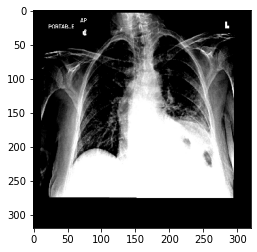
Multi-label classification performance: AUC scores for each pathology including Cardiomegaly (0.93), Edema (0.90), Effusion (0.87), and other conditions from the ChestX-ray14 dataset.
Training & Optimization Log
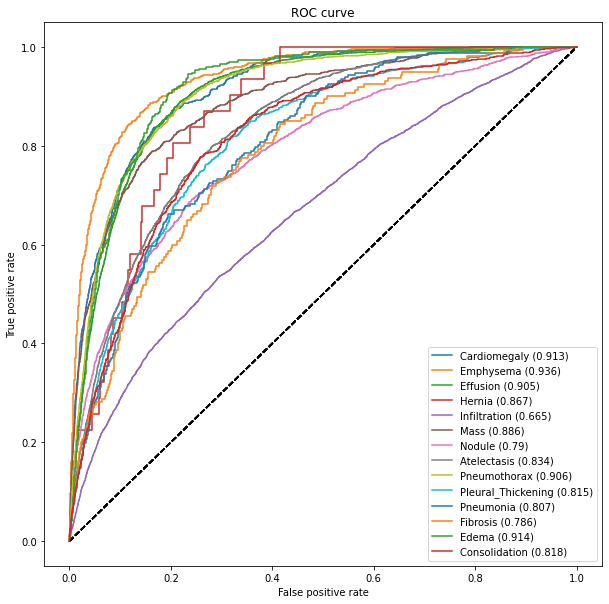
The training history plot for DenseNet-121 shows the loss stabilization over 100 epochs. The use of a weighted binary cross-entropy loss function was critical in handling the multi-label nature of the data.
ROC Analysis Metrics
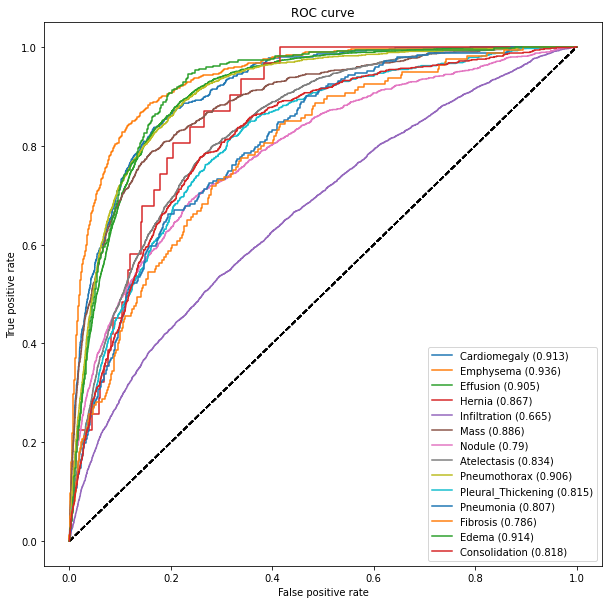
The evaluation metrics highlights the model's ability to maintain high sensitivity across multiple pathological conditions, with strong AUC scores for primary labels like Cardiomegaly and Pneumothorax.